“Report once”: ESMA paves the way for the biggest reform of transaction reporting since MiFID II
On 2 July 2026, ESMA published its Final Report on the comprehensive simplification of transaction reporting. This is the result of the so-called ‘Holistic Review’ covering MiFIR, EMIR and SFTR.
The message is clear: piecemeal adjustments are no longer sufficient.
ESMA recommends a structural overhaul towards an integrated ‘report once’ framework, with eight short-term relief measures, some of which can already be implemented without legislative procedures and which pave the way towards a ‘report once’ solution.
For financial institutions, market infrastructures and corporates subject to reporting obligations, this marks the start of a transformation process that will extend into the early 2030s, the foundations of which will be laid in the coming months.
Why this report marks a turning point
The reporting obligations under MiFIR, EMIR and SFTR have developed in separate silos over more than a decade. Reporting entities know the practical consequences only too well: the same transaction is reported multiple times via different channels, using differing formats, validation rules and feedback mechanisms. Parallel amendment cycles across the individual regulatory regimes generate ongoing waves of implementation rather than one-off project costs. Most recently, this was evident with the implementation of EMRI Refit and adjustments to ARM and APA reporting, which had to be managed independently of one another.
ESMA has now quantified this burden comprehensively for the first time. An independent cost-benefit analysis involving market participants, extrapolated to the total population of reporting entities, puts the ongoing annual operating costs of the three regimes at up to 4.2 billion euros. Three cost drivers stand out in particular:
– the frequency and lack of coordination of regulatory changes
– duplicate reporting via fragmented channels
– and dual-sided reporting under EMIR and SFTR, with its time-consuming reconciliation processes.
The long-term vision: an integrated framework, an infrastructure
At the heart of the ESMA recommendation is long-term target scenario 2a, which was described as one of four alternatives in the initial ‘Call for Evidence’: in future, market participants will report transaction data once, using a standardised, modular template that covers the requirements of all three regimes. Crucially, ESMA does not view ‘report once’ as a mere legal consolidation. The report explicitly calls for a redesign of end-to-end data flows, including the consolidation of trade repositories and ARMs into a single reporting structure or a central repository.
The economic rationale is robust and evidence-based: the cost-benefit analysis shows that the implementation costs will be recouped after around three to four years, followed by annual savings of 22 to 24 per cent of ongoing operating costs. This is close to the 25 per cent target set by the European Commission for reducing regulatory reporting burdens. This results in a cumulative net benefit of up to 4.9 billion euros over a ten-year horizon.
A reduction in running costs of 9 to 11 per cent is also forecast for the supervisory authorities involved. Overall, a positive outcome is therefore expected.
What is noteworthy here, however, is the varied distribution of benefits:
– Buy-side, sell-side and non-financial counterparties stand to benefit;
– Market infrastructures, on the other hand, will need to adapt to structural changes in their business models and make investments.
Eight measures to provide short-term relief
As the full implementation of the target scenario is not realistically expected until around mid-2031, ESMA is recommending a package of independent interim measures in the meantime. Two of these require Level 1 amendments by EU legislators:
Extension of delegated reporting: In future, for transactions between financial and non-financial counterparties, the financial counterparty will, as a general rule, be responsible for reporting on behalf of both parties, with the elimination of transaction reconciliation at the trade repository level. For non-financial counterparties, which account for around 55 per cent of reporting entities but generate less than 10 per cent of the reporting volume, this represents the most significant reduction in the reporting burden. For financial counterparties, however, a further increase in the reporting burden is to be expected.
Streamlining of the intragroup exemption under EMIR: a single central EU notification instead of parallel notifications to several national supervisory authorities, and a reduction in the reporting frequency for aggregated positions from weekly to monthly.
Six further measures fall within the Level 2/3 framework and are therefore largely within ESMA’s direct remit:
– the reduction of the back-reporting horizon under MiFIR from five to three years,
– targeted exemptions from the reporting obligation for transactions that are not relevant to market abuse monitoring,
– the de-prioritisation of selected optional RTS 22/23 fields,
– adjustments to the EMIR reconciliation fields,
– the simplification of the errors and omissions framework,
– and the exclusion of failed settlements from the SFTR reporting obligation; the latter is directly linked to the forthcoming T+1 transition in the EU.
Outlook, timetable
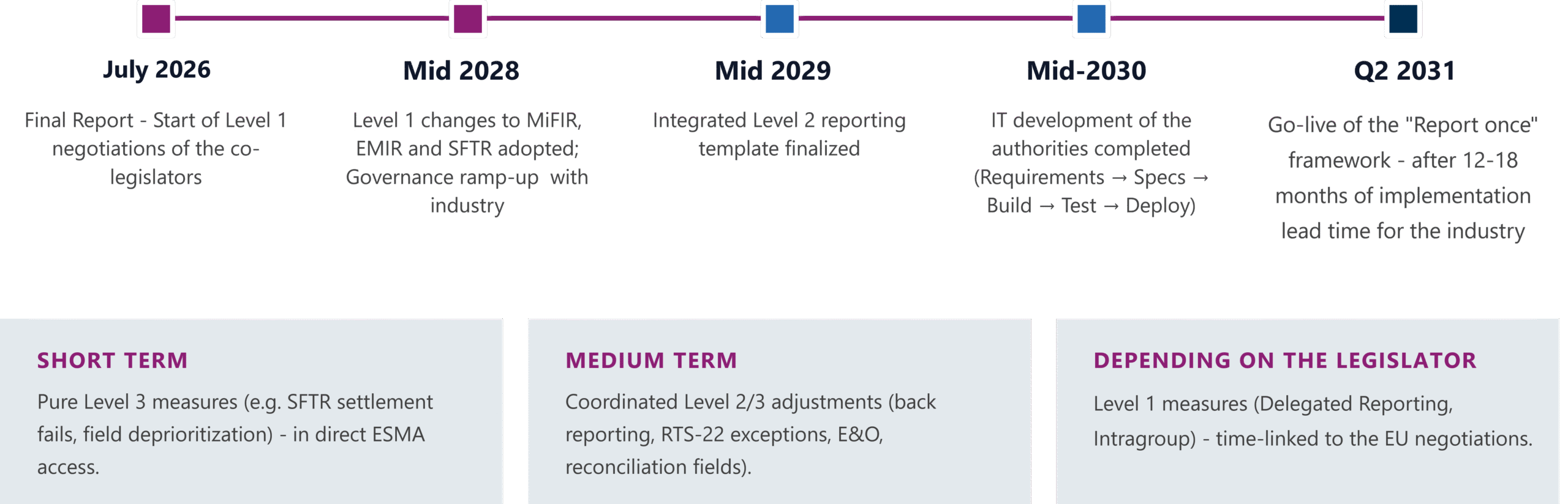
ESMA is now entering into policy negotiations to establish the legal framework for the ‘report once’ approach and the Level 1 regulations required for this and for the immediate measures. Assuming this is completed by mid-2028, the next steps could unfold as outlined below:
What those required to report should do now
Even if the timeframe seems long, the report sets out clear compatibility requirements against which every investment decision in the reporting environment must now be assessed. The focus is on three key areas:
Making future-proof architectural decisions.
ESMA expressly warns against stopgap solutions that are incompatible with the target model and generate sunk costs. Anyone modernising reporting systems, selecting providers or redesigning interfaces today should already be taking the ‘report once’ approach – standardised data models, consolidated channels, modular templates – into account.
Identify opportunities for short-term cost savings.
Level 2/3 measures, in particular, can take effect promptly. A structured analysis of your organisation’s reporting landscape, such as:
– Which fields, processes and reconciliation efforts are affected?
– Where can specific savings be made?
provides the basis for realising cost savings early and quickly.
Taking an active role in shaping the transition phase.
ESMA has announced an iterative design process involving close industry engagement, modelled on the governance model used for the T+1 transition. Institutions that actively participate in consultations and technical working groups at an early stage will help shape the future framework, rather than simply having to implement it reactively at a later date.
Our conclusion
The ESMA Final Report is more than just another consultation paper: it sets out the strategic direction for European transaction reporting over the next decade. The combination of a clear vision, robust cost-benefit evidence and pragmatic immediate measures creates pressure to act on two fronts: short-term optimisation and long-term transformation must be considered together.
Be Shaping the Future supports financial institutions and market infrastructures throughout the entire regulatory reporting chain: from impact analysis through functional design to technical implementation – and, if desired, based on our own reporting solution, tecconTR, in accordance with MiFIR, EMIR REFIT and SFTR, with integration into all standard ESMA trade repositories, including the current cost leader, KDPW.
Please get in touch if you wish to assess the impact of the Holistic Review on your reporting landscape and draw up a ‘report once’-compatible roadmap.